

ZQLexPort

CCMA: Patient Positioning

Positioning patients correctly for exams and procedures is a routine medical-assistant task. These CCMA questions cover the common positions — Fowler’s, supine, lithotomy, and more — and when each is used, each with a full rationale.

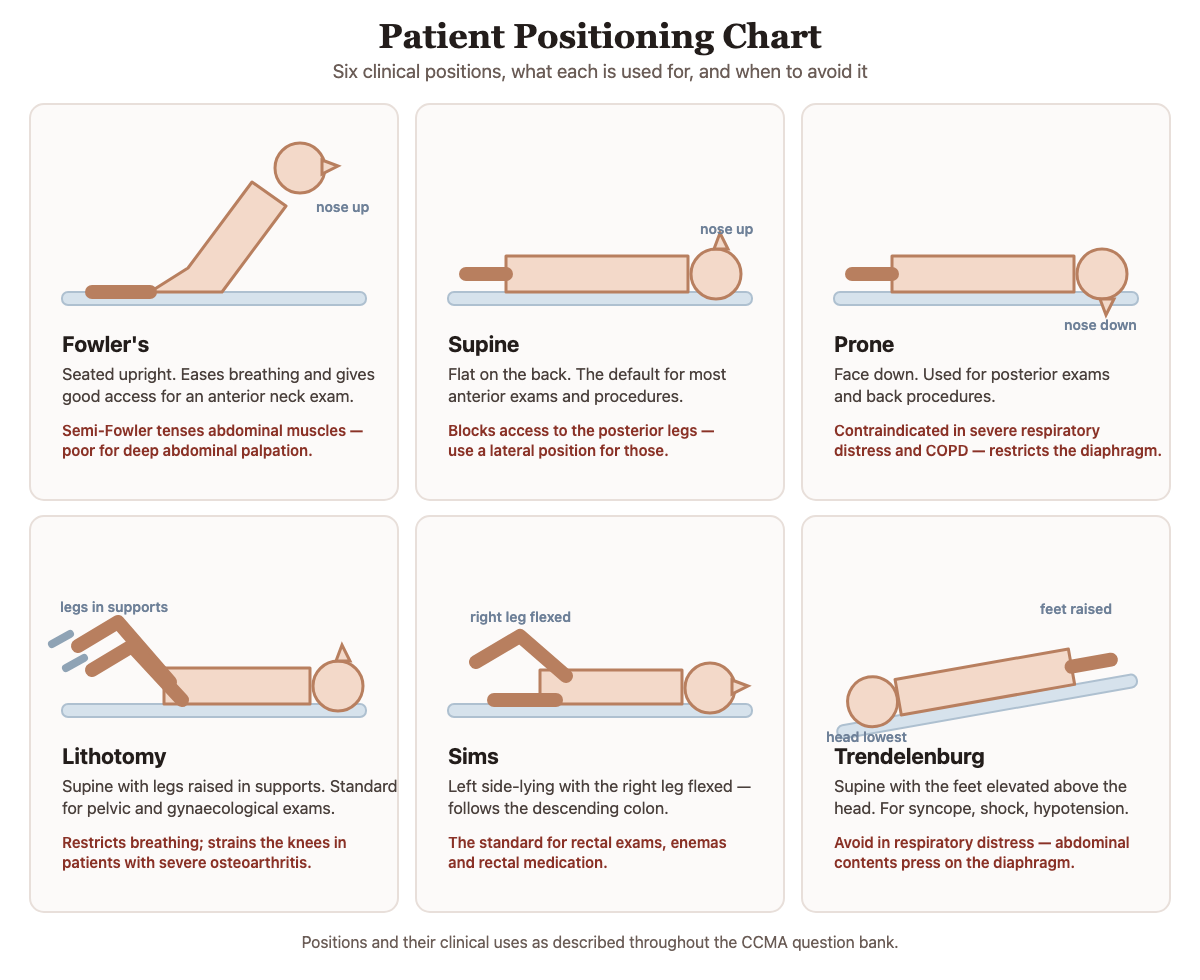
Patient positioning chart showing six clinical positions in side view: Fowler's seated upright, supine flat on the back, prone face down, lithotomy with legs raised in supports, Sims left side-lying with the right leg flexed, and Trendelenburg with the feet elevated above the head
Six clinical positions, what each is used for, and when to avoid it. Uses and contraindications as described throughout the CCMA question bank.

2,300+

questions in the app

10+ yrs

exam-prep publishing

Free

on iOS & Android

Built to help you pass faster — by exam-prep publishers with 10+ years' experience

  • 💡 Key Takeaways — the one transferable rule per question
  • 🔍 Hint highlights — the decisive cue phrases in each stem
  • 📖 Full rationales — why every option is right or wrong

Every CCMA question is written to the current exam outline for quick learning and a clear pass strategy.

Written and reviewed by the LexPort exam-prep team, led by our Founder & Exam-Prep Lead. LexPort builds certification practice questions — this is exam-preparation material, not medical advice. Last reviewed August 2026.

Get the full CCMA question bank — free

2,300+ practice questions with rationales on iOS & Android

Test yourself: CCMA: Patient Positioning

Three CCMA practice questions on ccma: patient positioning — tap an answer for instant feedback. The app has 2,300+, timed and scored.

Question 1

A forty-year-old patient facing a minor biopsy becomes extremely overwhelmed in the examination room, curls into a fetal position on the exam table, and cries for his mother. Which defense mechanism is this adult patient demonstrating?

▸ Why C is the answer

The correct answer is C because the adult patient is reacting to the stress of the procedure by reverting to childlike behaviors, such as crying for a parent and assuming a fetal position. This perfectly illustrates regression. Option A is incorrect because the patient is acutely aware of the procedure and not ignoring it. Option B is incorrect because the patient is not blaming the medical assistant or provider for their own anxiety. Option D is incorrect because the patient is actively expressing distress rather than unconsciously hiding a memory. Recognizing stress-induced regression helps medical assistants respond with appropriate comfort rather than judgment.

🔑 Key takeaway

Regression involves reverting to an earlier stage of development when faced with overwhelming stress.

Question 2

A provider orders a posterior lower limb assessment for a 70-year-old patient who has advanced chronic obstructive pulmonary disease. Which position provides the necessary anatomical access while safely accommodating the patient's underlying respiratory condition?

▸ Why C is the answer

Examining the posterior lower limbs typically requires the patient to lie face down. However, patients with severe COPD often experience significant respiratory compromise when placed prone, as the position restricts diaphragmatic movement and chest expansion. The lateral recumbent position provides a safe alternative, allowing the provider to view the posterior legs while keeping the patient's chest free to expand for adequate breathing. Option A is incorrect because the supine position blocks direct visual and physical access to the posterior aspects of the legs. Option B is incorrect because the prone position, even with a pillow, is contraindicated for patients with severe respiratory distress. Option D is incorrect because the lithotomy position is designed for pelvic and gynecological exams, not for assessing the posterior lower extremities, and can also restrict breathing.

🔑 Key takeaway

Lateral recumbent positioning allows posterior access without restricting chest expansion in patients with severe respiratory disease.

Question 3

A 55-year-old patient is scheduled for a rectal examination and medication instillation. The patient recently underwent right hip replacement surgery. Which position should the medical assistant select to ensure optimal provider access and maintain patient safety?

▸ Why C is the answer

The left lateral recumbent position, often modified into the Sims position, is the clinical standard for rectal exams and enemas because it aligns with the natural anatomy of the descending colon for optimal rectal access. Flexing the right knee exposes the anal area. Because the patient had recent right hip surgery, lying on the left side protects the operative site from bearing weight. Option A is incorrect because lying on the right side would place direct, unsafe pressure on the newly replaced hip. Option B is incorrect because the prone position is generally less comfortable for rectal access and doesn't utilize gravity for instillation. Option D is incorrect because while supine with bent knees offers some access, it provides less optimal exposure and comfort than the left lateral approach.

🔑 Key takeaway

Left lateral recumbent positioning optimizes rectal access while protecting the right hip from weight-bearing pressure.

Unlock all 2,325 CCMA practice questions, including 15 full-length mock exams

Timed, scored, with progress tracking and every answer explained. Free to start.

Question 1

A 28-year-old patient with swimmer's ear is receiving corticosteroid otic drops. After positioning the patient with the affected ear facing upward, how should the medical assistant manipulate the ear structures during and immediately after instillation?

  • A) Pull pinna down and back, then massage the lobule.
  • B) Pull pinna up and back, then massage the lobule.
  • C) Pull pinna down and back, then massage the tragus.
  • D) Pull pinna up and back, then massage the tragus.✓

💡 Key Takeaway

For adults, pull the pinna up and back and massage the tragus to facilitate medication flow.

Show rationale

For a 28-year-old patient, the pinna must be pulled up and back to straighten the adult ear canal. After instilling the drops, gently massaging the tragus helps move the medication down the canal. Option D is correct. Option C is incorrect because pulling down and back is for children under three. Options A and B are incorrect because massaging the lobule does not effectively facilitate medication flow into the ear canal compared to tragus massage.

Question 2

A provider needs to evaluate a suspicious pigmented lesion located directly on the mid-thoracic spine of a 45-year-old patient. Which positioning technique is most appropriate for this specific clinical assessment?

  • A) Prepare the exam table for supine positioning.
  • B) Prepare the exam table for prone positioning.✓
  • C) Prepare the exam table for Fowler's positioning.
  • D) Prepare the exam table for dorsal recumbent.

💡 Key Takeaway

The prone position is required for examining the posterior surface of the body.

Show rationale

The prone position requires the patient to lie flat on their stomach, providing optimal access for examining the posterior body surface such as the spine. Supine positioning blocks all access to the back. Fowler's positioning keeps the patient seated, making a thorough spinal examination difficult. Dorsal recumbent positioning also obscures the patient's back.

Question 3

A patient with severe bilateral knee osteoarthritis is preparing for a gynecological exam in the lithotomy position. Which action should the medical assistant take?

  • A) Support the patient's legs with soft pillows.✓
  • B) Place the patient in a prone position.
  • C) Keep the patient in a standing position.
  • D) Force the patient into standard metal stirrups.

💡 Key Takeaway

Alternative leg support should be used for patients unable to tolerate standard stirrups due to joint issues.

Show rationale

When a patient has severe bilateral knee osteoarthritis, placing them in the standard lithotomy position can cause significant joint strain. The medical assistant should support the patient's legs with soft pillows or alternative rests instead of using standard stirrups. A prone position (Option B) or standing position (Option C) does not allow the provider pelvic access. Forcing the patient into standard stirrups (Option D) ignores the patient's comorbidities and risks causing injury.

Question 4

A 19-year-old patient faints during a venipuncture but regains consciousness after being placed supine. After resting for fifteen minutes, the patient states they feel completely fine and wants to drive home. What should the medical assistant do?

  • A) Allow the patient to leave and drive home immediately.
  • B) Require the patient to consume a large, heavy meal.
  • C) Advise the patient to remain for further medical observation.✓
  • D) Perform a second venipuncture to complete the required tests.

💡 Key Takeaway

Patients who experience syncope must be observed and should not drive immediately, even if feeling recovered.

Show rationale

After a patient experiences syncope, they should not immediately drive, even if they feel fine, due to the risk of a secondary fainting episode. The medical assistant must advise the patient to remain for observation and ideally have someone else drive them home. Allowing immediate departure (Option A) poses a severe safety and liability risk. While offering juice or water is standard, requiring a heavy meal (Option B) is unnecessary and could cause nausea. Attempting a second venipuncture right after a syncopal episode (Option D) is contraindicated as it will likely trigger another fainting spell.

Question 5

A patient requires immediate manual irrigation for a left eye chemical splash. To implement the safest patient positioning strategy, how should the medical assistant align the patient's head?

  • A) Position the patient with the head tilted toward the right.
  • B) Position the patient with the head perfectly straight and neutral.
  • C) Position the patient with the chin tucked firmly downward completely.
  • D) Position the patient with the head tilted toward the left.✓

💡 Key Takeaway

Tilt the patient's head toward the affected side during eye irrigation to protect the healthy eye.

Show rationale

Proper positioning during a unilateral eye flush utilizes gravity to protect the unaffected eye. By ensuring the head is tilted toward the left, the contaminated runoff flows down the side of the patient's face and into a collection basin. Option D is correct because it prevents the chemical from crossing the bridge of the nose and entering the healthy right eye. Option A is incorrect because tilting toward the right would actively direct the hazardous chemical runoff into the unaffected eye. Option B is incorrect because a neutral, flat position allows fluid to pool and potentially spill over into the other eye. Option C is incorrect because tucking the chin downward does not control the lateral flow of the contaminated fluid away from the healthy eye.

Master CCMA: Patient Positioning in the CCMA app

You've seen a sample. Get the complete experience — a timed exam simulator, every rationale, and progress tracking that shows exactly what to study next.

This page is a free preview of CCMA: Patient Positioning. The app has the complete CCMA: Patient Positioning set, plus the full 2,300+ CCMA bank, timed mock exams, and offline study.

  • ✓ The complete CCMA: Patient Positioning set
  • ✓ 2,300+ real CCMA questions
  • ✓ Timed exam simulator — real conditions
  • ✓ Every answer explained + key takeaway
  • ✓ Tracks your weak topics
  • ✓ Works offline · Free to start

Get the full CCMA question bank — free

2,300+ practice questions with rationales on iOS & Android

CCMA · Exam Simulator

A 28-year-old patient with swimmer's ear is receiving corticosteroid otic drops. After positioning the patient…

A) Pull pinna down and back, then massage t
B) Pull pinna up and back, then massage the
C) Pull pinna down and back, then massage t
D) Pull pinna up and back, then massage the
Submit Answer

Authoritative sources